一、导读
近年来,太赫兹超材料在无标记生物传感领域展现出广阔的应用前景,但其检测灵敏度往往受限于热点区域的电场增强效率与待测分子在空间上的低重叠度,尤其对于极低浓度生物分子的特异性识别仍面临挑战。
近日,福建省太赫兹功能器件与智能传感重点实验室在国际知名期刊《Sensors and Actuators B: Chemical》(中科院1区TOP,IF:7.7)发表了题为“Intense terahertz field confined metallic nanoarchitectures for targeted actively capturing and specific biosensing via multi-step surface functionalization”的论文。本文创新性地提出了一种结合纳米间隙超材料与多步表面化学修饰策略的太赫兹生物传感器,实现对目标分子的特异性捕获与高灵敏度检测。利用SiO₂中间层增强局域电场,并结合多步骤表面功能化将SPB精确修饰于热点区域,通过SPB与链霉亲和素的强特异性结合,实现了目标分子的靶向主动捕获,检测限低至150 fM。该工作为开发高灵敏度、高特异性的太赫兹生化传感平台提供了新思路。实验室2021级博士生林廷玲为本论文的第一作者,实验室主任钟舜聪教授、实验室黄异老师和孙福伟老师是本文的共同通讯作者。
二、内容简介
本研究通过优化槽宽与中间层厚度,构建了具有强局域场增强效应的纳米间隙结构。进一步结合3-甲基苯硫酚(3-MTP)与硅烷化反应,分别修饰金表面与纳米间隙内的二氧化硅区域,将SPB精确固定于热点区域,实现对目标分子的主动捕获。

Figure. 1. THz nanoslot specific biosensor. a, Schematic illustration of THz sensor for specific capture of streptavidin into optical hotspots. b, Simulated transmittance spectra of nanoslot arrays. c, Simulated electric field enhancement over nanoslot. d, Cross-sectional field distribution at the center of the slot (y = 0). e, Near-field integrated intensity along the longitudinal direction within the nanoslot. f, Field enhancement along the z-axis at the hotspot.
通过在金属与基底之间引入20 nm SiO₂中间层,可在纳米间隙内形成非对称结构,显著增强局域电场,并实现与生物分子尺度相匹配的空间分布。
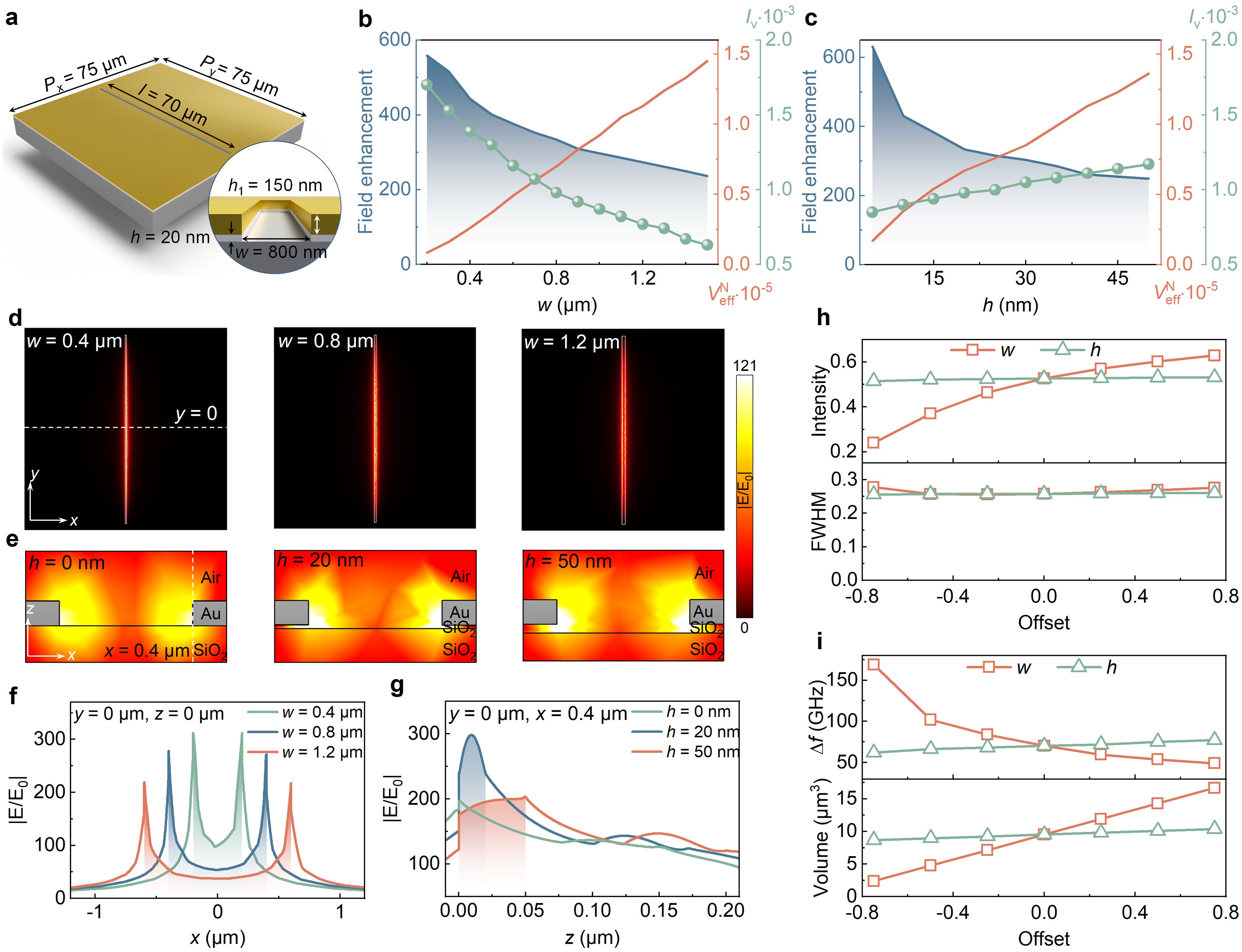
Figure. 2. Optimization of structural parameters. a, Schematic diagram of nanoslot unit. b-c, Calculated field enhancement, VN eff, and Iv as functions of w (b) and h (c). d-e, Simulated field distribution at different w (d) and h (e). f, Evaluated THz field enhancement at the center of the nanoslot along the x-axis. g, Evaluated THz field enhancement at the edge of the slot along the z-axis. h, Calculated resonance intensity and FWHM versus offset from w and h. i, Calculated frequency shift and analyte volume versus offset from w and h, considering only the spatial volume within the nanogap.
采用微纳加工工艺制备高质量纳米间隙阵列,进一步结合X射线光电子能谱验证了多步表面修饰策略的可行性。
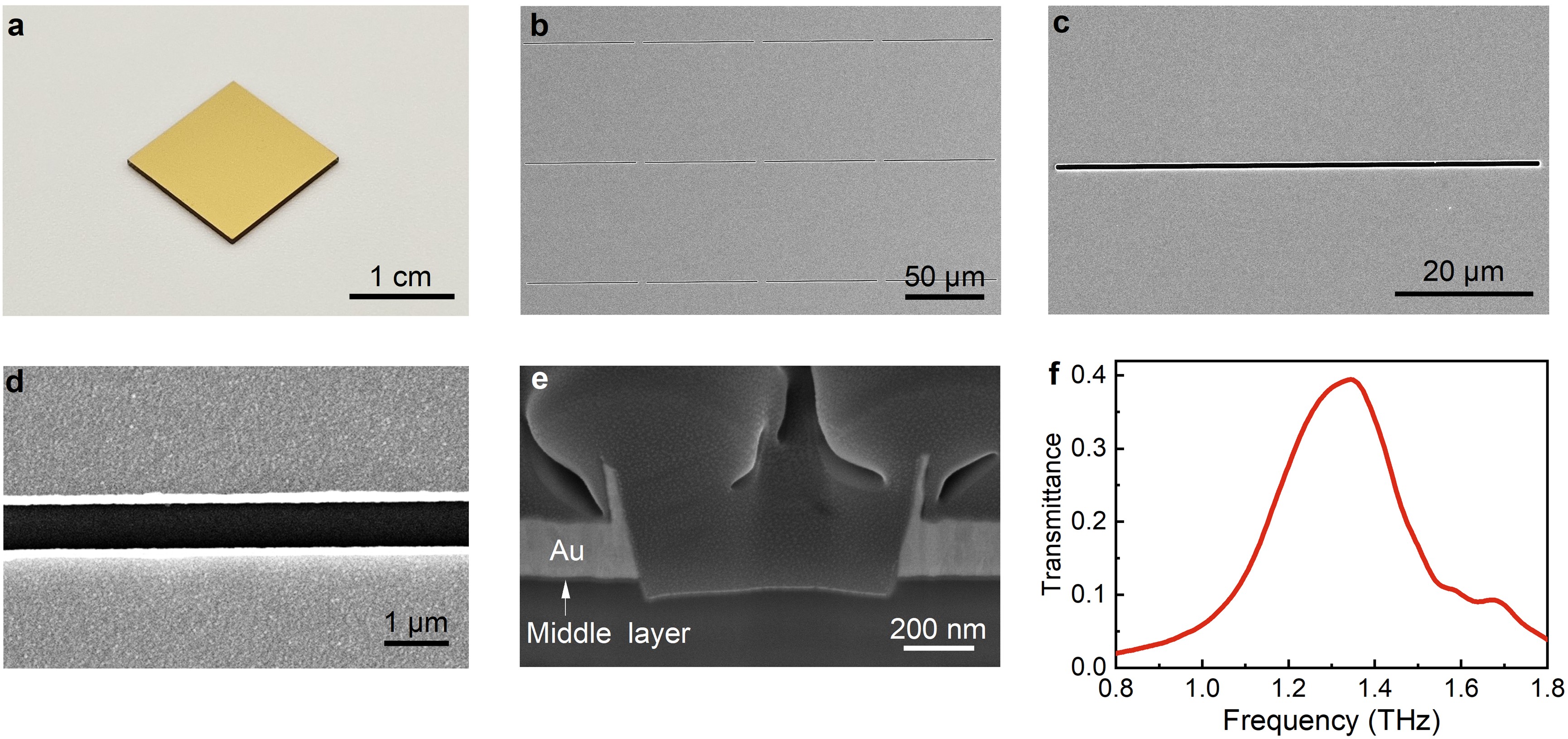
Figure. 3. Structural and spectral characterization of metamaterials. a, Actual image of the metamaterial sensor. b-c, SEM images of the metamaterial unit structure. d-e, SEM images showing the frontal and cross-sectional views of the 800 nm nanoslot. f, Transmittance spectral characterization of the metamaterial sensor.

Figure. 4. Feasibility validation for specific active capture. a, Scheme showing the two-step surface modification. b-c, Full range XPS spectra of the modified Au sheet (b) and corresponding high-resolution XPS spectra of S2p (c). d-e, Full range XPS spectra of the modified SiO2 sheet (d) and corresponding high-resolution XPS spectra of N1s (e).
实验测试表明,传感器在150 fM至150 nM浓度范围内展现出显著的共振频移响应,检测限达150 fM。在存在BSA、IgG、Cyt-C等干扰分子的复杂体系中,传感器仍保持对链霉亲和素的特异性响应,验证了其在复杂生物样本中的实用潜力。
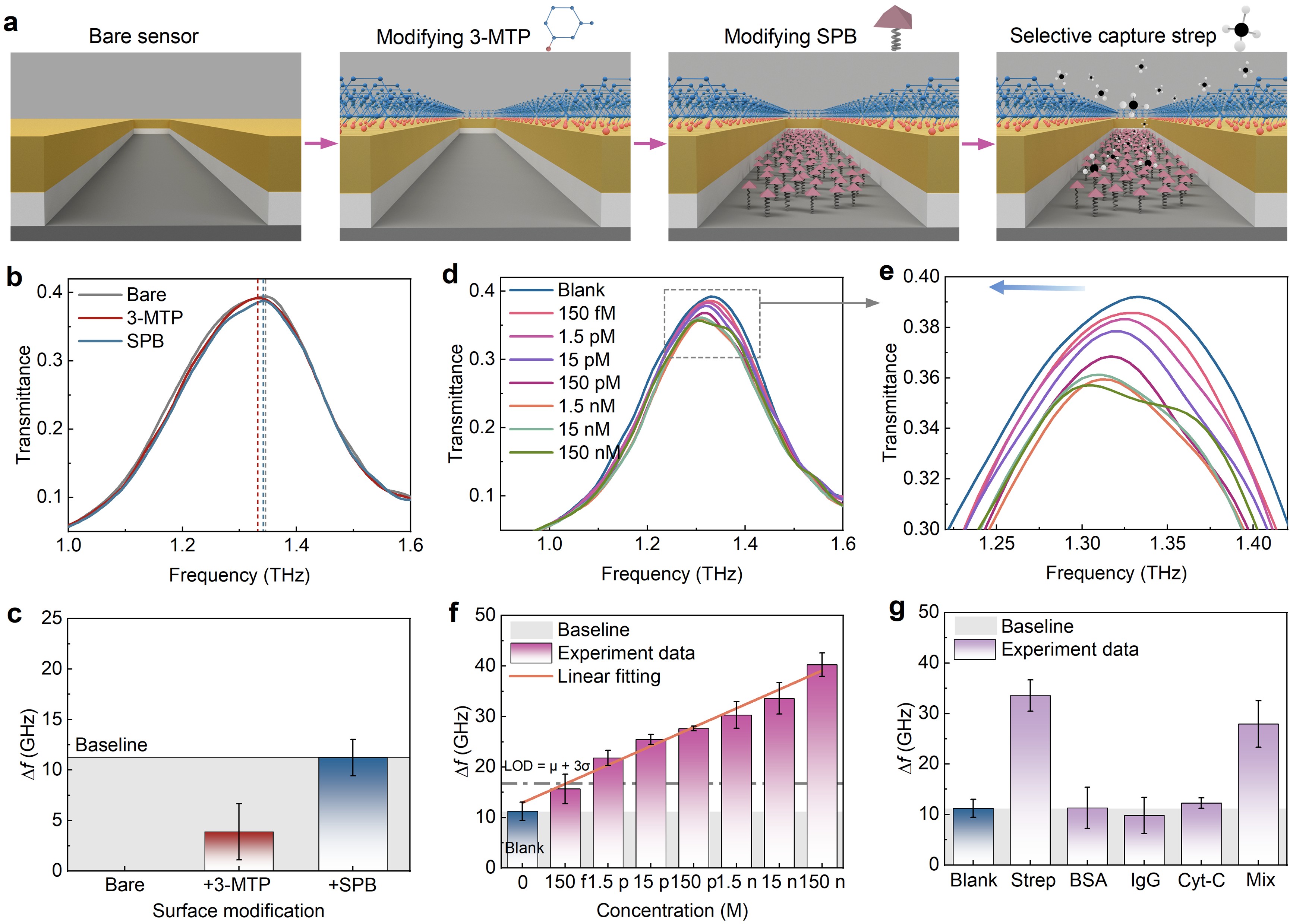
Figure. 5. Surface functionalization for molecular capture and specific detection. a, Schematic illustration of the surface modification strategy for the specific detection of streptavidin. b, Transmittance spectra of the blank sensor as well as after surface modification with 3-MTP and SPB. c, Resonance frequencies extracted from the transmittance spectra after modification, with the system modified with SPB serving as the baseline. d, Experimental transmission spectra for streptavidin at different concentrations (ranging from 150 fM to 150 nM), along with an amplified version of the resonance peak positions in (e). f, Resonance frequency shift versus streptavidin concentration. g, Resonance responses of the sensor to different solutions in the presence of interfering molecules (BSA, IgG, Cyt-C) within the complex biological medium.
三、总结
本研究基于纳米间隙超材料与多步表面化学修饰策略,设计并实现了一种具有主动捕获能力的太赫兹生物传感器。通过将强场受限结构与选择性表面修饰策略相结合,成功将目标分子引导至热点区域,实现了对链霉亲和素的高灵敏度(150 fM)和高特异性检测,有效克服了传统太赫兹传感器在低浓度检测中分子随机分布与热点区域不匹配的难题,为开发下一代高灵敏度太赫兹生化传感平台提供了新范式。
原文链接
https://doi.org/10.1016/j.snb.2026.139794
